

A 1960 nickel rarely draws attention — until condition, mint variety, and collector demand align.
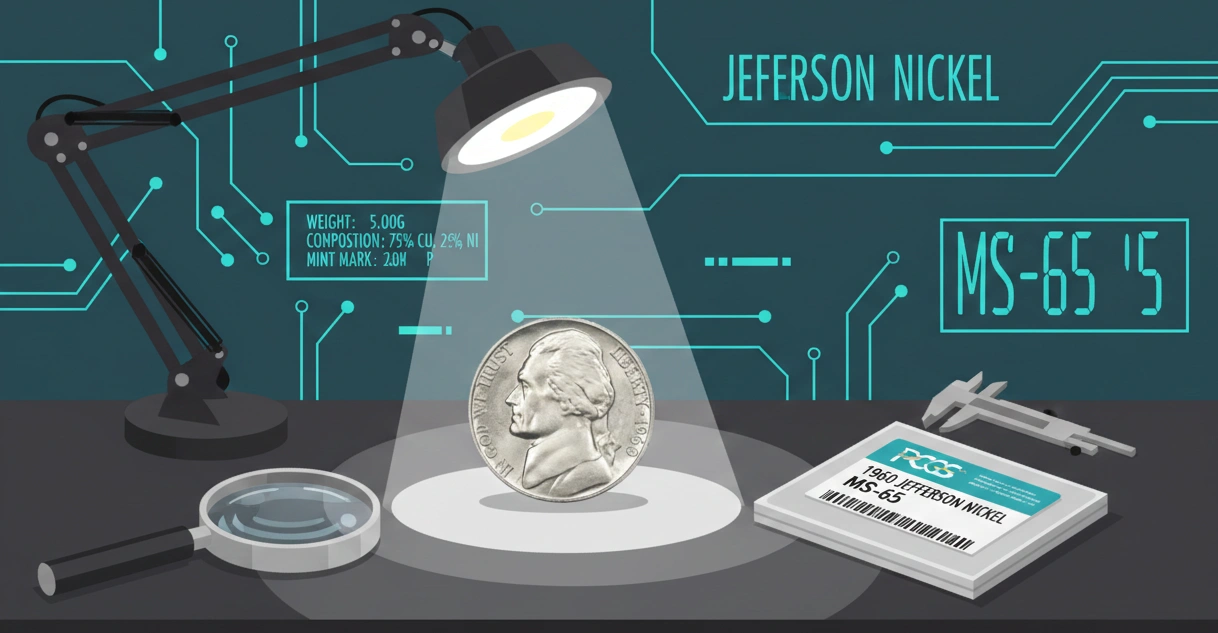
Issued as part of the Jefferson series starting in 1938, this coin follows standard US Mint specifications.
Each piece weighs 5 grams and measures 21.2 millimeters across.
Made from 75% copper and 25% nickel, the metal content matches other nickels from this era.
Felix Schlag designed the obverse featuring Thomas Jefferson and the reverse showing his Monticello home.
The edge remains plain without any grooves or lettering.
Most specimens found in circulation are valued at face 1960 nickel value, or by metal weight.

| Parameter | Value |
| Denomination | 5 Cents |
| Mint Year | 1960 |
| Material | Copper-Nickel Alloy |
| Mass | 5.00 g |
| Diameter | 21.21 mm |
| Thickness | 1.95 mm |
| Designer | Felix Schlag |
Production Figures of the Mints
In 1960, minting occurred at two main facilities: Philadelphia and Denver.
Coins produced in Philadelphia do not bear a mint mark.
Denver issues were marked with the letter “D” located on the reverse to the right of the building.
The total emission volume exceeded 250 million specimens distributed unevenly between the facilities.
1960 Mintages
- Philadelphia (no mark): 55,416,000 pieces
- Denver (D mark): 193,018,210 pieces
- Philadelphia (Proof): 1,691,602 pieces
Exceeding Philadelphia’s figures by 3.5 times, the Denver Mint’s production dominates the market.
Market availability of coins in average condition stems directly from this proportion.
Condition Analysis and Grading
Preservation levels, measured by the Sheldon scale ranging from 1 to 70 points, directly dictate the coin’s value.
Specimens falling below MS60 (Mint State) rarely present interest for investment collecting.
Significant price appreciation occurs upon reaching the MS65 level and above.
Detailed inspection focuses on the Monticello steps located on the reverse.
Applying to coins with five or six clearly defined horizontal lines, the term Full Steps (FS) indicates superior strike quality.
Blurring of these details in 1960 often resulted from insufficient die contact or equipment wear.
Occurring significantly less frequently than standard issues, coins with the FS designation command high premiums.
Comparative Rarity by Grade (PCGS/NGC)
- MS60-MS63: Mass segment consisting of millions of surviving specimens
- MS64: Transitional category having a moderate price premium
- MS65: High preservation requiring professional grading
- MS66: Rare condition for Philadelphia issues
- MS67: Exceptional preservation recorded in isolated cases
Market Dynamics and Auction Records
Pricing for 1960 nickels demonstrates volatility depending on certification.
Valued higher than Denver counterparts at the same grade, specimens without a mint mark remain more desirable.
Lower mintage and specific minting quality of that year cause this price disparity.
Auction Data for 1960 (Philadelphia)
- Grade MS67 FS: The record price reached 5,170 dollars at a Heritage auction in 2018
- Grade MS66+: Average market value varies from 400 to 600 dollars
- Grade Proof-69 Deep Cameo: Valued at approximately 150–200 dollars
Auction Data for 1960-D (Denver)
- Grade MS67: The record is fixed at 3,738 dollars
- Grade MS65: Value usually does not exceed 20–30 dollars
- Grade MS66 FS: An extremely rare combination for Denver this year valued over 1,000 dollars
Statistics show an annual price increase for rare positions at a rate of 4–6%.
Losing real value due to inflation, coins of low grades (below MS64) lack investment potential.
Minting Errors and Varieties
Production defects occurring during the stage of die preparation or minting increase collection value.
Several types of production errors were recorded in 1960.
Re-punched Mint Mark (D over D)
Superimposing one “D” symbol on another with an offset, this variety is easily identified under magnification.
Upon discovery of a clear doubling, the price of a coin in MS60 condition rises to 50–100 dollars.
Doubled Die Obverse (DDO)
Appearing as thickening of the letters in the motto “IN GOD WE TRUST”, Double Die Obverse occurs less frequently.
Such specimens require confirmation by expert laboratories.
| Error Type | Condition | Approximate Price (USD) |
| RPM (D/D) | MS63 | 45 |
| Off-center 10% | AU | 25 |
| Die Crack | UNC | 15 |
| Clipped Planchet | MS60 | 35 |
Proof Quality Issues
Produced exclusively in Philadelphia, Proof quality coins served collectors’ needs.
Annual Proof Sets provided the primary distribution channel for these strikes.
Evaluating these coins requires measuring the contrast between the mirrored field and the frosted relief.
Three categories are distinguished:
- Standard Proof: Ordinary mirrored surface
- Cameo (CAM): Noticeable contrast between the field and the portrait
- Deep Cameo (DCAM): Maximum contrast found in a small percentage of the mintage
Restricted by low survival rates, the number of 1960 coins in PR69 DCAM grade is extremely limited.
Exceeding the cost of standard Proofs by 10–15 times, these specimens represent the pinnacle of the issue.
Investment Potential and Risks
Accounting for liquidity is essential when considering the 1960 nickel as a financial instrument.
Possessing low liquidity at auctions, coins in MS65 condition and below are difficult to liquidate.
Short-term investments in ordinary specimens become unprofitable due to auction house commissions reaching 20%.
Attributing Full Steps status remains the only way to maintain stable demand for top grades.
Showing a cumulative growth of about 45% over the ten-year period (2014–2024), the MS66 FS segment remains a strong performer.
Characteristics for Verification
- Integrity of the lines on the Monticello steps
- Presence or absence of the D mint mark
- Degree of wear on the hair details of Jefferson’s portrait
- Cleanliness of the fields and absence of deep bag marks
Reasons for Value Decrease
- Traces of cleaning with chemical compounds
- Artificial toning applied to hide defects
- Mechanical damage to the edge
- Cloudiness of mirrored surfaces on Proof coins
The 1960 nickel remains an object accessible to most numismatists.
Excluding any scarcity of ordinary coins, the mass nature of the mintage ensures long-term availability.
Execution quality of a specific die strike exclusively forms the premium segment.
Under otherwise equal conditions, coins from Philadelphia demonstrate better price dynamics compared to Denver issues.
Focusing on certified specimens of the highest preservation categories is advised for all investors.
- Total Mintage: 250,125,812
- Most Expensive Specimen: 5,170 USD
- Primary Metal: Copper (75%)
- Edge Type: Smooth
- FS Status: Decisive factor for price
